

How much does a Quantity Surveyor cost?
One of the first questions we are asked by clients considering appointing a Quantity Surveyor is a very reasonable one:
How much is it going to cost?
The answer is that there is no single standard fee for Quantity Surveying services.
Fees may be calculated as a percentage of the construction cost, a fixed lump sum, an hourly or daily rate, or a combination of these, depending on the nature of the project and the services required.
For a full Quantity Surveying service, a consultancy will normally consider the resources needed to deliver the project properly. This means looking at the level and experience of the Quantity Surveyor required, whether more than one member of the team will be involved, and approximately how much time each person will need to spend on the project at each stage.
On larger projects this is often developed into a detailed resource schedule, commonly aligned with the RIBA Plan of Work stages. This allows the consultancy to estimate the time required throughout the design, procurement and construction process and, in turn, calculate an appropriate fee.
It also allows the fee to be drawn down at appropriate points as the project progresses rather than simply dividing the total fee equally across the life of the project.
What percentage does a Quantity Surveyor charge?
As a broad guide, Quantity Surveying fees tend to reduce as a percentage as the construction value of a project increases.
A £1 million project, for example, does not necessarily require half the Quantity Surveying work of a £2 million project. There is a baseline amount of work required to understand the project, prepare cost plans, procure the works and administer the commercial aspects of the contract regardless of its overall value.
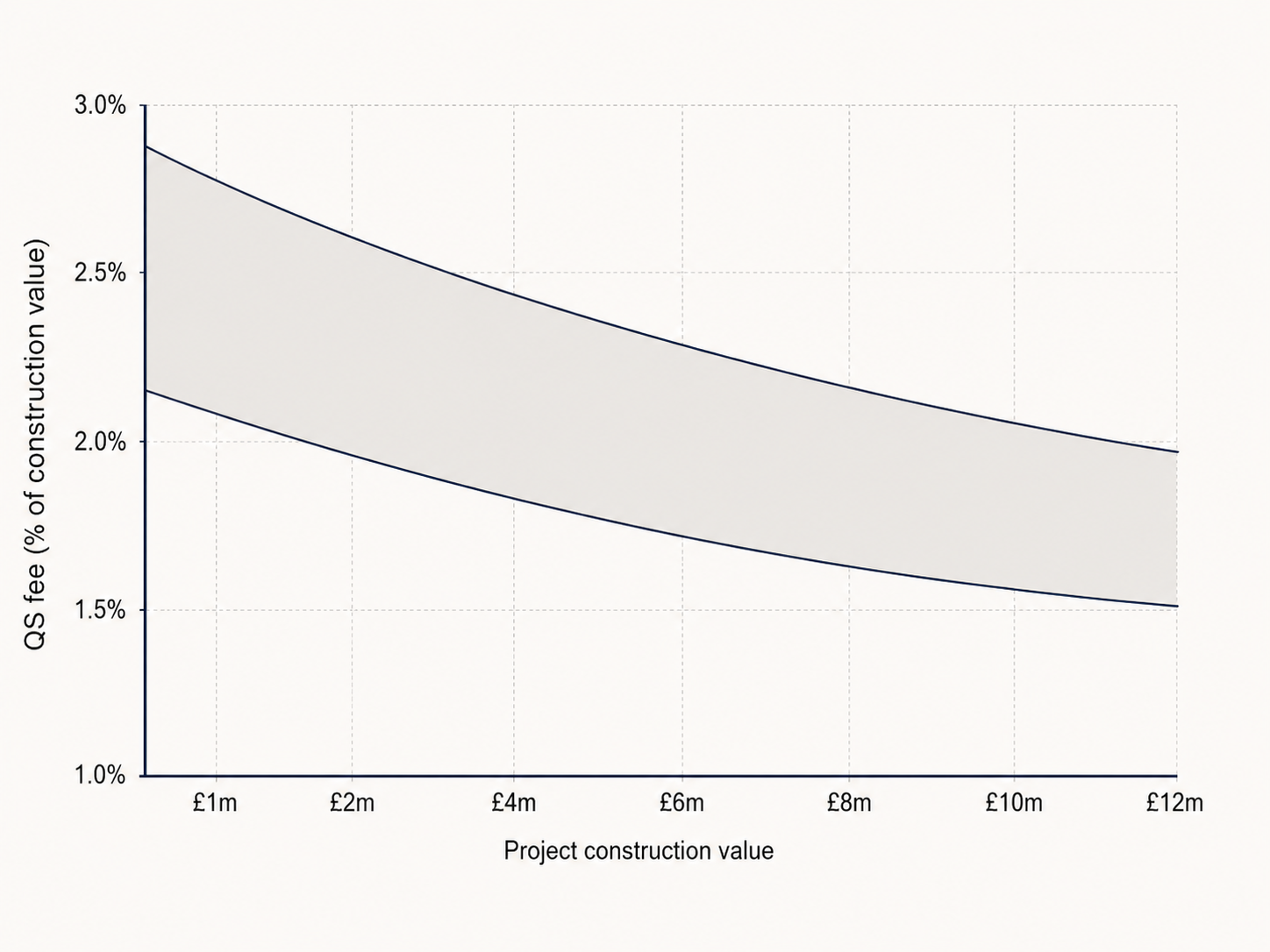
Indicative QS fee range by project construction value. Actual fees vary depending on project complexity, procurement route, programme and scope of service.
The figures shown above should only be used as a broad guide.
The actual fee for an individual project can vary significantly depending on its complexity, procurement strategy, programme and the scope of service required.
Two projects with exactly the same construction value can therefore result in quite different Quantity Surveying fees.
Why do Quantity Surveyor fees vary?
There are a number of factors that influence the amount of time a Quantity Surveyor will need to spend on a project. Some of the most significant are set out below.
Project value
Generally, larger projects require a greater overall Quantity Surveying input.
There may be more elements to measure and cost, larger tender documents, more contractor enquiries, a greater number of variations during construction and more detailed financial reporting.
However, as mentioned above, the relationship is not completely linear.
A £10 million project does not necessarily require ten times the QS input of a £1 million project, which is why professional fees expressed as a percentage of construction value will often reduce as project values increase.
Project complexity
Complexity can have a considerable effect on the amount of Quantity Surveying work required.
A relatively straightforward new-build project on a clear site is generally easier to cost and manage than the refurbishment or conversion of an existing building.
Heritage buildings, listed buildings and major renovations can involve considerably more uncertainty.
Existing structures need to be understood, works may only become apparent once areas are opened up, specialist trades may be required and the design is more likely to evolve as the project progresses.
All of this generally means more input from the Quantity Surveyor.
A £2 million refurbishment project can therefore require considerably more QS resource than a £2 million straightforward new-build project.
Procurement route
The way in which the construction work is procured can have a significant effect on professional fees.
At its simplest, a project may be tendered to a small number of main contractors under a single construction contract. The Quantity Surveyor prepares the tender information, analyses the tenders received and subsequently deals with one contractor during construction.
At the other end of the scale, the works may be divided into numerous individual trade packages.
In this situation, the Quantity Surveyor may be required to prepare and tender separate packages for groundworks, structural steelwork, roofing, windows, joinery, mechanical services, electrical services, finishes and numerous other trades.
There are then significantly more tenders to analyse, contracts or orders to manage, valuations to prepare and final accounts to agree.
This does not mean that procuring work through individual trade packages is necessarily more expensive overall. In the right circumstances there can be considerable benefits.
However, the client needs to recognise that some of the management function normally provided by a main contractor has effectively been transferred elsewhere. This usually means greater involvement from the client's project manager, design team and Quantity Surveyor, together with appropriate site management to coordinate the individual trades.
Programme
The construction programme has a particularly strong influence on post-contract Quantity Surveying fees.
During construction, the Quantity Surveyor will typically undertake a regular valuation of the works, assess variations and changes, update the anticipated final cost and provide the client with ongoing financial reporting.
On many projects this takes place monthly.
A project lasting 24 months will therefore require considerably more construction-stage QS input than an equivalent project completed in 12 months.
This is why it is important to check the programme assumptions included within a consultant's fee proposal.
A fee that appears particularly competitive may, for example, have been based on a 12-month construction period when the realistic programme is closer to 18 months.
Quality and quantity of information
The quality of the design information available can make a major difference to the amount of work required from the Quantity Surveyor.
A well-developed set of coordinated drawings, specifications and schedules allows quantities to be established accurately and tender information to be prepared efficiently.
Incomplete or frequently changing information requires considerably more work.
The Quantity Surveyor may need to make assumptions, revise previous cost plans, obtain additional information from the design team and repeatedly update the budget as the design develops.
There is nothing unusual about a design changing during the early stages of a project — that is part of the design process.
However, significant or repeated changes inevitably require additional consultant time.
The same applies during construction. Changes instructed after the building contract has been entered into can require quotations to be obtained, assessed and negotiated before their effect on the overall project budget can be properly established.
Level of service required
Not every client requires the same Quantity Surveying service.
For example, one client might only need an independent cost plan to establish whether a proposed project is financially viable.
Another might require a complete service including:
early feasibility advice;
cost planning throughout the design process;
value engineering;
procurement advice;
preparation of tender documents;
management of the tender process;
tender analysis and recommendation;
preparation of contract documents;
monthly valuations;
assessment of variations;
regular cost reporting;
commercial advice throughout construction; and
negotiation and agreement of the final account.
Clearly, the fee for these two appointments will be very different.
When comparing quotations from Quantity Surveyors, it is therefore important to compare the scope of service as well as the bottom-line fee.
Why can two Quantity Surveyors quote very different fees for the same project?
This is more common than you might expect.
Two consultancies can receive exactly the same project information and return significantly different fee proposals.
That does not automatically mean that one is expensive and the other represents better value.
They may simply have made different assumptions.
One consultant may have allowed for monthly site visits while another has assumed quarterly attendance. One may have included tendering, contract preparation and final account negotiations while another has excluded some or all of these services.
They may also have assumed different construction programmes or different levels of senior staff involvement.
Before appointing a Quantity Surveyor, therefore, it is worth checking:
exactly what services are included;
which services are excluded;
the assumed construction value;
the assumed design and construction programme;
how frequently the QS will attend site;
how frequently cost reports and valuations will be produced;
whether tendering is included;
whether contract preparation is included;
whether variation assessment is included; and
whether agreement of the final account is included.
The cheapest fee is not necessarily the best value.
Equally, the most expensive fee does not automatically mean the best service.
The important thing is understanding exactly what you are buying.
Is a Quantity Surveyor worth the cost?
That depends on the project.
On a relatively small and straightforward piece of work, appointing a Quantity Surveyor to provide a full service may simply not be necessary.
As the value, complexity and financial risk of a project increase, however, the case for professional cost management becomes much stronger.
A Quantity Surveyor's role is not simply to find ways of making a project cheaper.
A good QS should help the client understand what the project is likely to cost, where the financial risks lie and what effect decisions made throughout the project will have on the final cost.
That can include identifying omissions from early budgets, testing design proposals against the available budget, ensuring tenders are compared on a like-for-like basis, assessing contractor valuations and variations, and continually forecasting the likely final cost.
In many cases the value of the QS is therefore not simply measured by identifying a particular saving.
It is about giving the client sufficient information to make informed decisions before committing significant sums of money.
When might you not need a Quantity Surveyor?
It may sound strange for a Quantity Surveying consultancy to say this, but not every construction project needs a QS.
If you are carrying out relatively small, straightforward works with a contractor you know and trust, working to a clearly defined scope and with limited financial exposure, a full Quantity Surveying appointment may cost more than the value it provides.
As the project becomes larger or more complicated, the balance starts to change.
Refurbishment projects, multiple tender packages, listed buildings, projects with significant design development and projects involving substantial sums of money all create greater financial risk.
There is no magic construction value at which a Quantity Surveyor suddenly becomes essential.
The better question is:
How much financial risk am I comfortable managing without independent professional cost advice?
How does Tantallon Projects calculate its fees?
At Tantallon Projects, we do not apply one standard percentage to every project.
We consider the scope of service required, anticipated construction value, complexity, procurement strategy and programme and then estimate the resources required to deliver the appointment properly.
Depending on the project, our proposal may therefore include a fixed fee for the pre-contract stages followed by a monthly fee during construction, a lump-sum fee for a clearly defined piece of work, or an hourly or daily rate for specific advice.
Our fee proposals also set out the assumptions on which the fee has been calculated so that clients can understand both what is included and what may cause the fee to change.
What information is needed to obtain an accurate QS fee?
If you are requesting a Quantity Surveying fee proposal, providing as much of the following information as possible will help:
the location of the project;
a brief description of the proposed works;
any available drawings or specifications;
the approximate construction budget;
the current stage of design;
the intended procurement route, if known;
the anticipated construction programme; and
the services you expect the Quantity Surveyor to provide.
Don't worry if you don't have all of this information yet.
Particularly at the early stages of a project, that is completely normal and a Quantity Surveyor should be able to help you establish what information is still required.
Want to understand what level of Quantity Surveying support your project needs?
If you are planning a construction project and would like to understand the likely QS input and fee, you can arrange an informal project call with Tantallon Projects.
We'll discuss the project, where you currently are in the process and the level of cost management we think would be appropriate — including telling you if we don't think you need a full Quantity Surveying service.
